















Tinkerbot uses screen-less learning to transform early coding education
A cutting-edge educational tool called Tinkerbot is revolutionizing the way young students learn to code in a world where screens are taking over. Tinkerbot is a screenless coding bot that was created specifically for first-year students. It stresses practical learning, creativity, and logical thinking without requiring constant digital exposure. Tinkerbot has simple physical buttons that [...]

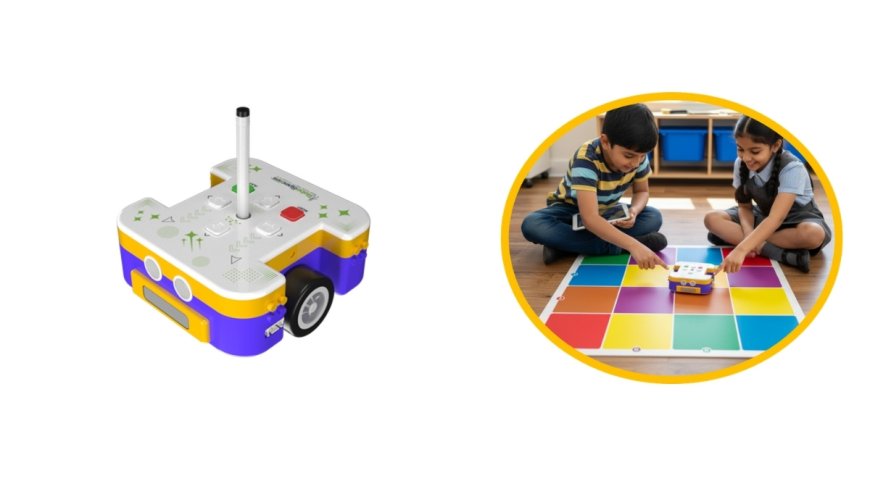

A cutting-edge educational tool called Tinkerbot is revolutionizing the way young students learn to code in a world where screens are taking over. Tinkerbot is a screenless coding bot that was created specifically for first-year students. It stresses practical learning, creativity, and logical thinking without requiring constant digital exposure.
Tinkerbot has simple physical buttons that let kids program directed movements and actions, in contrast to traditional coding platforms that mainly rely on computers and tablets. Students can create sequences, navigate paths, and solve challenges by simply pressing commands on the bot, making coding concepts tangible and interesting.

Tinkerbot’s distinctive “Bubble Coding” environment—a specially created method that streamlines sequential coding—is what really makes it stand out. Through interactive play, this approach helps kids grasp basic programming concepts like sequencing, logic building, and navigation.

In addition to its screen-free features, Tinkerbot has built-in Wi-Fi and Bluetooth connectivity, providing students with more advanced learning options as they advance. Both a mobile app and the web-based platform Tinkerbrix.cc, where students can experiment with Python programming and Scratch-based block coding, can be used to program the bot. This guarantees a smooth progression from fundamental to sophisticated coding abilities.
Tinkerbot’s versatility is further enhanced by its support for AI-based control and remote operation, which exposes students to cutting-edge technologies early on. Teachers think that this combination of digital and unplugged learning equips students not only for coding but also for an innovative and automated future.
Tinkerbot has received praise from educators and parents for lowering screen dependency while simultaneously promoting critical 21st-century abilities like creativity, computational thinking, and problem-solving.
Tools like Tinkerbot are anticipated to play a significant role in forming the next generation of innovators as schools continue to incorporate STEM education into their curricula, demonstrating that sometimes the best way to learn technology is to get away from the screen.
A: TINKERBOT AND INDIA’S NEW EDUCATION VISION: A PERFECT ALIGNMENT WITH NCF & NEP 2020
As India moves towards a more holistic and skill-based education system under the National Education Policy 2020 and the evolving National Curriculum Framework, innovative learning tools like Tinkerbot are emerging as powerful enablers in classrooms. Designed as a screenless coding solution for early learners, Tinkerbot aligns seamlessly with the foundational goals of experiential, competency-based, and multidisciplinary education.
Education experts highlight that Tinkerbot is not just a coding device—it is a comprehensive learning tool that integrates key developmental areas such as numeracy, computational thinking, spatial understanding, and problem-solving, all of which are central to NEP 2020 and NCF.
B: Building Foundational Numeracy Through Play
One of the core focuses of NEP 2020 is Foundational Literacy and Numeracy (FLN). Tinkerbot supports this by allowing children to count steps, measure distances, and understand sequencing through physical movement.
For instance, when students program the bot to move forward 5 steps and turn right, they are subconsciously applying counting, estimation, and logical sequencing—making abstract numerical concepts concrete and meaningful.
C: Strengthening Computational Thinking
Both NCF and NEP emphasize computational thinking as an essential 21st-century skill. TinkerBot introduces this through the following:
- Step-by-step command execution
- Logical sequencing using Bubble Coding
- Debugging when the bot does not follow the expected path
Without even realizing it, students begin to think like programmers—breaking problems into smaller steps and creating logical solutions.
D: Understanding Shapes, Patterns, and Spatial Awareness
Tinkerbot activities naturally integrate mathematical concepts like shapes and patterns:
- Drawing geometric shapes (square, triangle, rectangle) through movement
- Recognizing repeating patterns in navigation sequences
- Understanding direction, angles, and spatial positioning
This aligns with NCF’s focus on learning by doing and developing conceptual clarity in mathematics rather than rote memorization.
E: Exploring Colors and Visual Learning
Through interactive mats and environments often used with Tinkerbot, students engage with colors and visual cues:
- Navigating towards specific colored zones
- Associating commands with visual outcomes
- Enhancing observation and recognition skills
This supports multisensory learning, a key recommendation in early childhood education under NCF.
F: Enhancing Critical Thinking and Problem Solving
At the heart of NEP 2020 is the shift from rote learning to critical thinking and problem-solving. Tinkerbot encourages this by presenting challenges such as:
- Reaching a destination using minimum steps
- Avoiding obstacles
- Correcting errors in command sequences
Students learn to analyze, predict, test, and सुधार (improve) their solutions—developing a scientific and inquiry-based mindset.
G: Learning Without Screens: A Balanced Approach
One of the most significant contributions of Tinkerbot is its screenless approach, which aligns with NCF’s emphasis on reducing passive screen time in early years. Children engage physically and cognitively, ensuring:
- Better attention and retention
- Active participation
- Healthier learning habits
At the same time, its integration with platforms like Tinkerbrix.cc allows a gradual transition to digital coding (Scratch and Python), supporting continuity in learning.
H: A Step Towards Experiential and Holistic Education
Tinkerbot embodies the core vision of NEP 2020—“learning how to think, not what to think.” By combining play, logic, movement, and technology, it transforms classrooms into innovation labs where students learn through exploration and experimentation.
As schools across India adopt new-age pedagogies, tools like Tinkerbot are proving that the future of education lies in blending tradition with technology—thoughtfully, creatively, and purposefully.
SCRATCH CODING POWERS TINKERBOT: BRIDGING PLAYFUL LEARNING WITH DIGITAL SKILLS
In an exciting development for early STEM education, Tinkerbot, the screenless coding companion for young learners, now integrates seamlessly with Scratch coding—one of the world’s most widely used beginner-friendly programming platforms. Through the dedicated web platform Tinkerbrix.cc, students can now code and control Tinkerbot using intuitive block-based programming.
https://app.tinkerbrix.cc/scratch

Developed by the MIT Media Lab, Scratch has long been recognized as a powerful entry point into coding for children. Its visual drag-and-drop interface allows students to create programs without worrying about syntax, making it ideal for foundational learning.
I: From Screenless to Screen-Based: A Seamless Transition
Tinkerbot’s integration with Scratch via Tinkerbrix.cc ensures a smooth progression in learning:
- Students begin with physical button-based coding on Tinkerbot
- Move to Bubble Coding for understanding sequences
- Transition to Scratch coding on Tinkerbrix.cc for digital programming
This layered approach aligns with modern pedagogy—starting from concrete experiences and gradually moving toward abstract thinking.

J: How Scratch Enhances the Tinkerbot Experience
By using Scratch on https://app.tinkerbrix.cc/scratch, learners can:
- Create step-by-step movement programs for Tinkerbot
- Design interactive navigation paths
- Experiment with loops, conditions, and events
- Instantly test and debug their logic by observing the bot’s actions
This not only strengthens computational thinking but also builds confidence in coding through immediate, visible results.
K: Aligned with Future-Ready Skills
The integration of Scratch coding ensures that Tinkerbot is not limited to early learning—it becomes a scalable platform that grows with the student. As learners advance, they can further explore Python programming on Tinkerbrix.cc, moving from block-based to text-based coding.
Educators believe this combination of hands-on learning + digital coding prepares students for:
- Logical reasoning
- Creativity and innovation
- Real-world problem-solving
- Strong programming foundations
L: Making Coding Accessible to All
With Scratch being globally recognized and easy to use, its integration into Tinkerbot makes coding accessible, inclusive, and engaging. Students who may feel intimidated by traditional coding methods can now learn in a fun, visual, and interactive way.
If you object to the content of this press release, please notify us at pr.error.rectification@gmail.com. We will respond and rectify the situation within 24 hours.
What's Your Reaction?